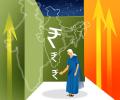
NITI Aayog member Arvind Virmani on Monday said India is set to become the fourth largest economy in the world by the end of 2025, an assertion which came days after NITI CEO BVR Subrahmanyam claimed India has already overtaken Japan to reach that spot. The International Monetary Fund (IMF), in its World Economic Outlook (WEO) report released in April had said that India is expected to be the fourth largest economy in the world with a GDP of $4.19 trillion in 2025, ahead of Japan.

Asian Development Bank on Wednesday lowered India's economic growth forecast for FY2019 to 5.1 per cent on slowing job prospects, rural distress exacerbated by poor harvest and credit crunch. Growth in FY2020 is likely to recover thanks to this support, low oil prices, and a weakening rupee, but risks to the projections remain tilted to the downside, it said on India.

The change in stance to neutral from accommodative in the June monetary policy meeting does not necessarily signal that the Reserve Bank of India's (RBI's) rate setting body - monetary policy committee (MPC) - will go on a prolonged pause on rate cuts going forward, believe experts.

Rating agency Fitch on Tuesday slashed India's growth forecast for the next fiscal to 8.5 per cent from 10.3 per cent, citing sharply high energy prices on account of the Russia-Ukraine war. With the Omicron wave subsiding quickly, containment measures have been scaled back, setting the stage for a pick-up in GDP growth momentum in the June quarter this year, the agency said. It has revised upwards the GDP growth forecast for the current fiscal by 0.6 percentage points to 8.7 per cent.

The Reserve Bank on Thursday marginally revised upwards the economic growth projection for the current fiscal to 6.5 per cent, from its earlier estimate of 6.4 per cent. Unveiling the first bi-monthly monetary policy of 2023-24 fiscal, RBI Governor Shaktikanta Das said the GDP growth in the first quarter of 2023-24 is expected at 7.8 per cent.

Moody's Investors Service on Friday raised India's growth projection for 2023 calendar year to 6.7 per cent on account of robust economic momentum. "Strong services expansion and capital expenditures propelled India's 7.8 per cent real GDP growth in the second (April-June) quarter from a year ago. "We have accordingly raised our 2023 calendar year growth forecast for India from 5.5 per cent to 6.7 per cent," Moody's said in its Global Macro Outlook. - el nino

In trade negotiations, as in chess, sometimes you need to accept a temporary disadvantage to secure a better long-term position, points out Sonal Varma, chief economist (India and Asia ex-Japan) at Nomura.

Deloitte India on Friday said it estimates India's GDP growth at 6.6 per cent in the current fiscal helped by consumption expenditure, exports rebound and capital flows. In its India's economic outlook report, Deloitte said the rapid growth of the middle-income class has led to rising purchasing power and even created demand for premium luxury products and services. With the expectation that the number of middle-to-high-income segments will be one in two households by 2030/31, up from one in four currently, we believe this trend will likely become further amplified, driving overall private consumer expenditure growth, it said.

Asian Development Bank (ADB) has kept its outlook for India's economic growth unchanged at 7 per cent for the current fiscal year while forecasting a weaker-than-previously expected pace for developing Asia. ADB's 7 per cent growth projection for fiscal 2022-23 (April 2022 to March 2023), unchanged from its September forecast, compares to 8.7 per cent GDP growth in 2021-22. For 2023-24, the GDP growth has been kept unchanged at 7.2 per cent.

The Reserve Bank on Friday retained the GDP forecast for the current financial year at 9.5 per cent and flagged global semiconductor shortages, elevated commodity prices and potential global financial market volatility as downside risks to economic growth. In his address after the three-day meeting of the rate-setting panel, RBI Governor Shaktikanta Das said recovery in aggregate demand gathered pace in August-September, and it is reflected in high-frequency indicators, like railway freight traffic; port cargo; cement production; electricity demand; e-way bills; GST and toll collections. "The ebbing of infections, together with improving consumer confidence, has been supporting private consumption," he said, and added the pent-up demand and the festival season should give further fillip to urban demand in the second half of the financial year.

China's GDP grew by 4.9 per cent in the third quarter, down from 7.9 per cent in the second, confirming the slowdown of the world's second-largest economy which was under pressure from the crisis-hit property sector, curbs on energy and tardy recovery from the Covid-19 pandemic.
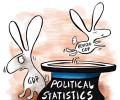
The SBI report, however, said the economic growth rate will pick up pace in 2020-21 to 6.2 per cent.

The government had pegged GDP growth around nine per cent in the Budget for 2011-12.

HSBC on Monday lowered India's GDP forecast for the current financial year to 4 per cent from 5.5 per cent earlier saying economic uncertainty is likely to weigh on the growth forecast in the coming months.

Fitch Ratings on Thursday cut India's GDP growth estimate by 10 basis points to 6.4 per cent for the current fiscal, but retained the projections for the next financial year, on concerns over a 'severe' escalation in global trade war. "It is hard to predict US trade policy with any confidence. Massive policy uncertainty is hurting business investment prospects, equity price falls are reducing household wealth, and US exporters will be hit by retaliation," Fitch said in its special update to quarterly Global Economic Outlook (GEO).
ICRA's GDP forecast is higher than the 6.0 per cent projection made by the Reserve Bank of India and Asian Development Bank for this fiscal.\n\n\n\n

The World Bank on Tuesday revised upwards its GDP growth forecast for India to 6.9 per cent for 2022-23, from 6.5 per cent earlier.

S&P Global Ratings on Monday raised India's growth forecast for the current financial year to 6.4 per cent, from 6 per cent, saying that robust domestic momentum has offset headwinds from high food inflation and weak exports. The US-based rating agency, however, has cut growth estimates for the next fiscal (2024-25) to 6.4 per cent, as it expects growth to slow in the second half (October-March) of the current fiscal, on higher base impact and subdued global growth.

S&P Global Ratings on Monday kept its forecast for India's economic growth unchanged at 6 per cent in the fiscal year starting April 1, before rising to 6.9 per cent in the following year. In the quarterly economic update for Asia-Pacific, S&P saw inflation rate easing to 5 per cent in 2023-24 fiscal, from 6.8 per cent in the current financial year. It saw India's gross domestic product (GDP) likely growing by 7 per cent in the current financial year ending March 31 (2022-23), before slowing to 6 per cent in the next 2023-24 fiscal.
India's economic growth prospects should remain strong over the medium term, with GDP expanding 6-7.1 per cent annually in fiscal years 2024-2026, S&P Global Ratings said on Thursday. In a report titled 'Global Banks Country-By-Country Outlook 2024', S&P said the banking sector's weak loans will decline to 3-3.5 per cent of gross advances by March 31, 2025, on the back of structural improvement, including healthy corporate balance sheets, tighter underwriting standards and improved risk-management practices. Interest rates in India are unlikely to rise materially, and this should limit the risk for the banking industry, it added.

The three day MPC meeting began on Monday and the decision will be announced on Wednesday by RBI Governor Shaktikanta Das.
Questioning the methodology of CSO in computing economic growth projections, the Planning Commission today said it has ignored the rising growth trend while working out estimates for 2012-13.

Stating that growth impulses and the fast-moving indicators are strong, Reserve Bank Governor Shaktikanta Das on Wednesday exuded confidence of the economy clipping at the projected 9.5 per cent this fiscal. Giving all the credit for the faster-than-expected recovery of the economy to the government, Das said the central bank has only been supporting the government in reviving the economy ravaged by the pandemic. Citing a slew of measures the government has taken since the pandemic struck in March 2020, the governor specifically mentioned tax cuts on fuels, tax resolution for the telecom sector, annulling of the retro tax legislation, sale of Air India, plans to sell some of the public sector banks and PLI scheme as the major reforms and growth-drivers bearing fruits now.

The Indian services sector growth touched a ten-month high in June aided by robust expansion in international sales and job creation, amid positive demand trends and ongoing improvement in sales, a monthly survey said on Thursday. The seasonally adjusted HSBC India Services PMI Business Activity Index rose from 58.8 in May to 60.4 in June, driven by sharp upturn in new business orders.

Gold seems to be losing its glitter in India due to a rise in prices. Demand in Q2CY24 was 149.7 tonnes - a 5 per cent drop compared to 158.1 tonnes in the same period last year, according to a report by the World Gold Council (WGC). Demand by value in April-June 2024 stood at Rs 93,850 crore, up by 14 per cent compared to Rs 82,530 crore in the same period last year.
A ramp-up in COVID-19 vaccination, healthy advance estimates of kharif (summer) crop and faster government spending were the factors which led to the revision, the agency said in a statement. It can be noted that after the 7.3 per cent contraction in 2020-21, there were expectations of a higher growth number in 2021-22.

The India Meteorological Department (IMD) has predicted above-normal rainfall for the upcoming monsoon season in India (June to September). The cumulative rainfall is estimated to be 105 percent of the long-period average. The IMD has also ruled out the possibility of El Nino conditions during the entire season. The monsoon is crucial for India's agriculture sector, which supports the livelihood of a significant portion of the population and contributes substantially to the country's GDP. However, while the prediction of normal rainfall brings relief, climate change is expected to cause variations in rainfall distribution.
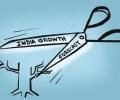
The International Monetary Fund (IMF) on Tuesday cut its projection of India's economic growth in 2022 to 6.8 per cent, as it joins other global agencies that have trimmed forecasts. The IMF had in July projected a gross domestic product (GDP) growth of 7.4 per cent for India in the fiscal year that started in April 2022. Even that forecast was lower than 8.2 per cent projected in January this year. India had grown at 8.7 per cent in 2021-22 fiscal (April 2021 to March 2022).
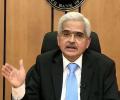
The Reserve Bank is unlikely to cut the benchmark interest rate in its forthcoming bi-monthly monetary policy review later in the week as retail inflation is still a cause of concern, and there is a possibility of the Middle East crisis deteriorating further, impacting crude oil and commodity prices, say experts.

India Inc's net profit as a percentage of the country's gross domestic product (GDP) is just shy of reaching 5 per cent, bolstered by strong earnings growth in the second quarter of 2023-24. Analysts interpret this as an indication that a corporate profit upcycle is in progress, with projections suggesting that this share could exceed 8 per cent within the next five years, driven by bullish earnings growth expectations. "We believe we are only halfway through a profit cycle, with the profit share in GDP rising from a low of 2 per cent in 2020 to about 5 per cent currently, and likely heading to 8 per cent in the coming four to five years. "This implies about 20 per cent compounding of earnings growth. "Underscoring this forecast is the start of a new private capex cycle, under-geared balance sheets, a healthy banking system, lower corporate tax rates, improving terms of trade, and structural consumption demand outlook albeit somewhat offset by likely consolidation in government deficit," said Ridham Desai, managing director, head of research, Morgan Stanley India in a note.
India's economy continues to be robust, but downside risks such as rising crude oil prices, adverse weather conditions, and the global banking crisis outweigh the upside potential in gross domestic product (GDP) growth in the current financial year (FY24), the finance ministry said on Tuesday in its Monthly Economic Review for March. "We reiterate that downside risks to our official forecast of 6.5 per cent for real GDP growth in FY24 dominate upside risks," the review said. "Opec's surprise production cut has seen oil prices rise in April, off their lows of low-seventies per barrel in March.

Goldman says the downgrade reflects the more difficult external funding conditions for Asia as markets increasingly anticipate Fed tapering and eventual exit from unconventional monetary policies.

Mixed views were expressed by top economists on the Reserve Bank of India's (RBI) Monetary Policy Committee's (MPC) decision to hold the repo rate at 5.5% and maintain a neutral stance. While some say the decision was as expected and one more rate reduction is expected this fiscal, there is also a view that rate cut by MPC was warranted given the evolving global situation.

The Reserve Bank of India's (RBI) Monetary Policy Committee's (MPC) decision to cut the repo rate by 50 basis points (bps) to 5.5% was contrary to the expectations of many economists. Firstly, most of the economists expected the MPC to cut the repo rate by 25 bps citing the weakening of inflation, prospects of economic growth, geopolitical uncertainty and comfortable system liquidity.
CMIE ups Indian 02-03 GDP growth forecast to 3.7%

Chief economist at State Bank of India has revised downward the full-year growth forecast to a low 6.8 per cent from 7.5 per cent earlier for FY2023, citing "the way below GDP numbers for the first quarter". The National Statistical Office on Wednesday released the Q1 growth numbers which showed a consensus growth of 13.5 per cent, pulled down by the poor show of the manufacturing sector, which reported a paltry 4.8 per cent expansion in the first three months of FY23, negating the robust show by the services sector. Consensus forecast was 15-16.7 per cent of which the RBI made the highest forecast of 16.7 per cent.
The Reserve Bank on Wednesday marginally lowered the country's GDP growth projection for the current fiscal at 6.8 per cent from its earlier estimate of 7 per cent. However, despite the downward revision in the economic growth projection, India will remain among the fastest growing major economies in the world, said RBI Governor Shaktikanta Das while announcing the latest bi-monthly monetary policy.

The southwest monsoon has arrived in Mumbai 16 days before its usual date, making it the earliest arrival since 1950. This early onset follows the monsoon's arrival in Kerala, the southernmost state, on Saturday, marking the earliest arrival since 2009. The India Meteorological Department (IMD) predicts an above-normal rainfall for the 2025 monsoon season, with rainfall between 96 per cent and 104 per cent of the 50-year average of 87 cm considered 'normal'. The monsoon is crucial for India's economy, providing vital water for agriculture and replenishing reservoirs.
The Indian economy will grow at around 6.5 per cent in the current fiscal, notwithstanding high crude oil prices and increased uncertainty due climate changes, NITI Aayog member Arvind Virmani said on Thursday. Virmani also asserted that the gross household savings ratio in India has consistently gone up. In an interview with PTI, he said: "My growth projection (of India's GDP growth) is 6.5 per cent plus minus 0.5 per cent... because my experience is that the fluctuations in global GDP more or less has balanced out for us, assuming normal changes."

However, the SBI report said it will take almost seven-quarters from Q4 FY21 to reach the pre-pandemic level in nominal terms and there will be a permanent output loss of around 9 per cent of GDP.
